If you’re trying to boost TripAdvisor review volume fast, the bottleneck is rarely guest satisfaction, it’s the ask. Many hotels running a genuinely strong guest experience still have a thin TripAdvisor review count. Satisfied guests get busy, forget, and move on. The review never happens.
TripAdvisor’s Popularity Ranking doesn’t reward silent satisfaction. It rewards volume, recency, and consistency. The hotel down the road with a slightly lower average rating but a steady stream of fresh reviews will often outrank you. That’s the uncomfortable truth, and it’s also the opportunity: review collection is an operational problem you can fix.
Below is a practical workflow you can put in motion this week: the tactics that actually move the needle, the templates you can send today, and the three metrics that tell you whether it’s working. Implement two or three of these together and most hotels see review volume climb within four weeks.
Why review volume and recency control your TripAdvisor ranking
TripAdvisor’s Popularity Ranking runs on three inputs: rating quality (the proportion of 4 and 5-bubble reviews), recency (how fresh those reviews are), and volume (how many reviews exist to confirm the rating is reliable). It’s a confidence-based algorithm, not a simple average. A hotel with 40 recent positive reviews will generally outrank one with a better average but only 10 older reviews. Volume and recency are the variables you control most directly.
Older reviews carry less algorithmic weight over time. A hotel that collected 50 reviews last year but has nothing recent is effectively losing ground to competitors who are actively collecting now. In a competitive city market with dozens of nearby properties, your ranking depends on your collection pace relative to the properties around you. This is an ongoing operational need, not a one-off campaign.
For an independent hotel in a competitive city market, industry heuristics suggest roughly 10 to 20 new reviews per month is the range needed to maintain or improve rank, with the upper end required to move meaningfully in saturated markets. A few scattered reviews won’t shift the needle if your competitors are consistently active.
The goal is a weekly review rhythm, not annual bursts. That framing matters because it changes how you build the workflow.
How to boost TripAdvisor review volume fast with post-stay automation
Response rates are highest when you contact guests within 24 to 48 hours of checkout, while the experience is still vivid. Engagement typically declines as more time passes, which means manual follow-up at this speed isn’t realistic for most independent hotels without a dedicated marketing team. Automation removes that bottleneck entirely: the message goes out at the right moment, every time, without relying on anyone to remember. TripAdvisor itself launched an automatic review request feature to streamline this process.
Why reminder sequences are the highest-yield addition to your workflow
A single message won’t reach everyone. Vendor data and industry benchmarks consistently indicate that a meaningful share of reviews collected through automated sequences, often reported in the 30 to 50 percent range, come from the second message, not the first. That alone makes reminders one of the most straightforward improvements to any TripAdvisor review collection workflow.
Automated follow-ups for non-responders remove the need for any manual chase. ReviewFilter includes reminder sequences as standard, which means response rates improve without additional staff involvement. The platform’s smart filtering routes positive feedback toward public review platforms while capturing negative feedback privately, giving management the chance to resolve a complaint and pacify the guest before the experience becomes a public one-star.
How staff training and in-stay touchpoints multiply your digital outreach
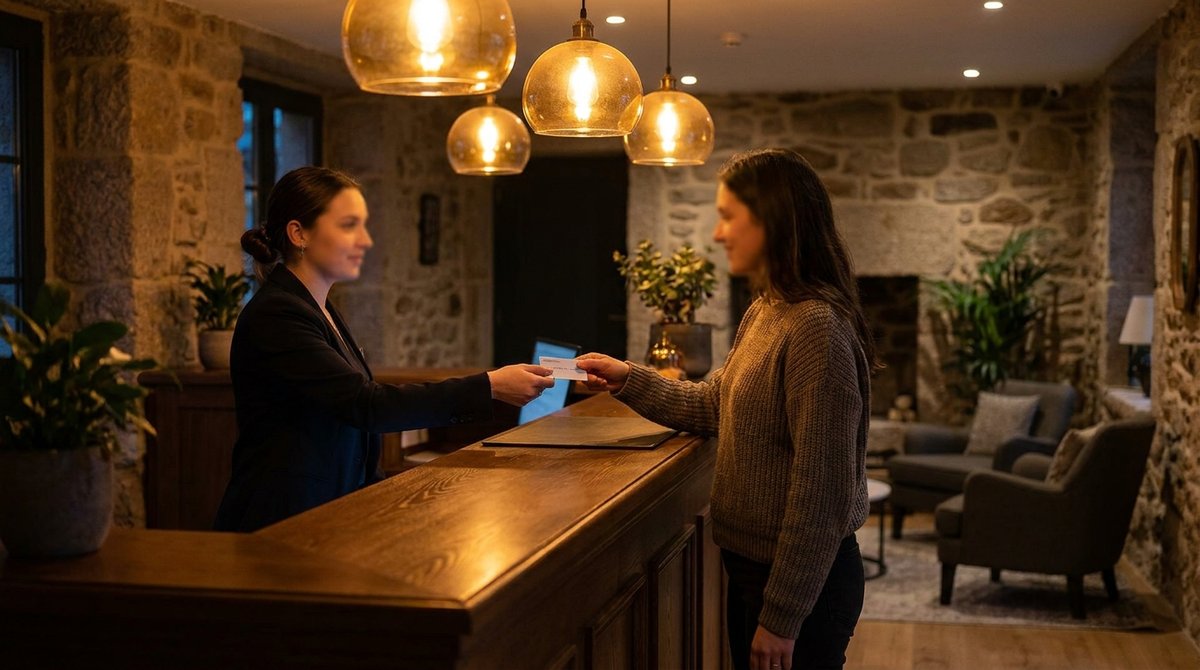
The post-stay email works best when it’s reinforced by a warm, in-person mention at checkout. A natural phrase from a front-desk team member, “we’d really appreciate it if you shared your experience on TripAdvisor”, increases the chance that a guest acts on the automated follow-up they receive later. Train staff to make the ask feel genuine rather than scripted, and time it during a positive farewell moment rather than as a transactional formality. If you run a small independent hotel, lean into this: the personal ask is one of the few channels where you can out-compete the marketing budgets of the bigger chains.
A mid-stay welfare check isn’t primarily a review tactic, it’s an issue-prevention tactic. Identifying a dissatisfied guest before checkout removes the cohort most likely to post a negative review and gives them a reason to leave a positive one instead. A simple mid-stay message like “just checking in to make sure everything is going well, let us know if there’s anything we can do” takes 30 seconds to send and can redirect a complaint that would otherwise go public.
Physical touchpoints add a parallel collection channel that requires no ongoing effort once set up. QR codes on stationery, checkout receipts, and in-room collateral serve guests who prefer to act immediately rather than wait for an email. A QR code on a checkout receipt gets seen at exactly the right moment, when the guest is leaving with the experience still fresh. These don’t replace automation, but they catch guests who won’t respond to a follow-up message.
TripAdvisor review request templates you can send today
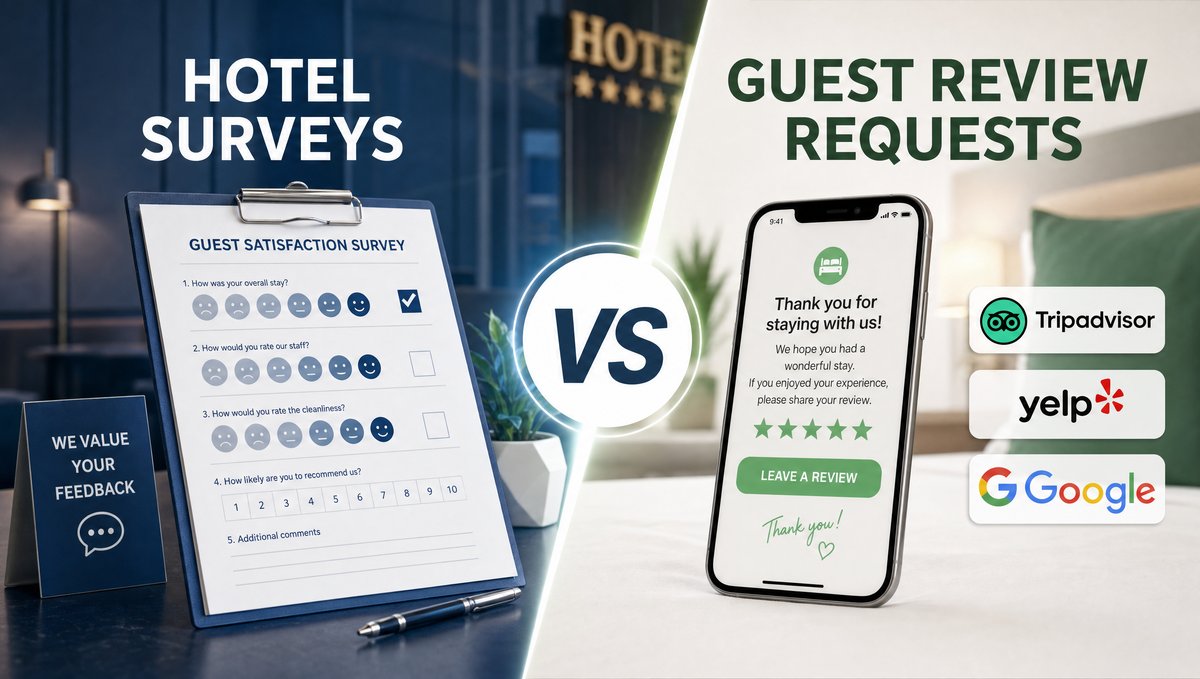
The three templates below are TripAdvisor-compliant starting points. Each asks for the guest’s experience rather than a specific rating, and all are designed to go to every guest without pre-screening. Personalise them with the guest’s name and stay details. For a full breakdown of why a plain text review request out-converts a long survey form, see our piece on hotel survey vs review request.
Post-stay email template
Subject: Thank you for staying with us at [Hotel Name]
Hi [First Name], thank you for choosing [Hotel Name]. We hope you had a great stay. We’d really appreciate it if you could take a moment to share your experience on TripAdvisor. Your feedback helps us improve and helps future travellers choose with confidence. Leave your review here: [TripAdvisor Link]. We hope to welcome you back soon. Best regards, [Hotel Manager]
Post-stay SMS template (under 160 characters)
Hi [First Name], thanks for staying at [Hotel Name]. We’d love to hear about your experience. Leave a quick review here: [Link]
Reminder follow-up template (for non-responders)
Hi [First Name], we know you’ve been busy since your stay, but if you have a moment we’d still love to hear about your experience at [Hotel Name]: [TripAdvisor Link]. Thanks again for staying with us. [Hotel Manager]
The metrics that tell you your strategy is working
Track three numbers every week: total new reviews posted, response rate (the percentage of contacted guests who leave a review), and review recency (how many reviews were posted in the last 30 days). These three metrics tell you whether the workflow is performing and where it needs adjustment. ReviewFilter’s performance dashboard surfaces review trends, satisfaction scores, and conversion rates in one view, though a simple spreadsheet works fine if you’re starting without dedicated software.
Set realistic timelines. Hotels running a properly configured automated sequence typically see meaningful volume increases within the first four to six weeks. Ranking movement tends to follow as fresh reviews accumulate over the following months and build algorithmic confidence. Track your competitive set alongside your own numbers: if nearby rivals are also collecting aggressively, raw volume alone isn’t the full story.
Use the data diagnostically. A low response rate means your timing or message tone needs adjustment. A high response rate with a low average star rating means an operational issue is surfacing in the feedback. Neither outcome is a problem, both give you something actionable to work with, which is exactly what a well-run workflow should produce.
Building a review collection habit that actually sticks
Bring the workflow together: post-stay automation sets the foundation, reminder sequences close the gap on non-responders, staff training amplifies the signal at checkout, and the templates above give you a starting point you can use today. The incremental resource requirement is typically low. Once automation handles the sequencing, the main investment is in the initial setup and staff briefing.
TripAdvisor review collection is not a one-month campaign. The hotels that climb rankings and stay there run a steady, compliant, automated workflow. A burst once a year followed by three quiet quarters will erode your gains, because recency weighting decays continuously.
If you want the automation, reminder sequences, smart filtering, and performance tracking handled in one place, ReviewFilter is built specifically for hotel and restaurant reputation management. See the Lite, Core and Pro plans for the side of the workflow you don’t want to build in-house, so your team’s focus stays where it belongs: on delivering the experience that earns the reviews in the first place. That’s how to boost TripAdvisor review volume fast, and keep it growing.