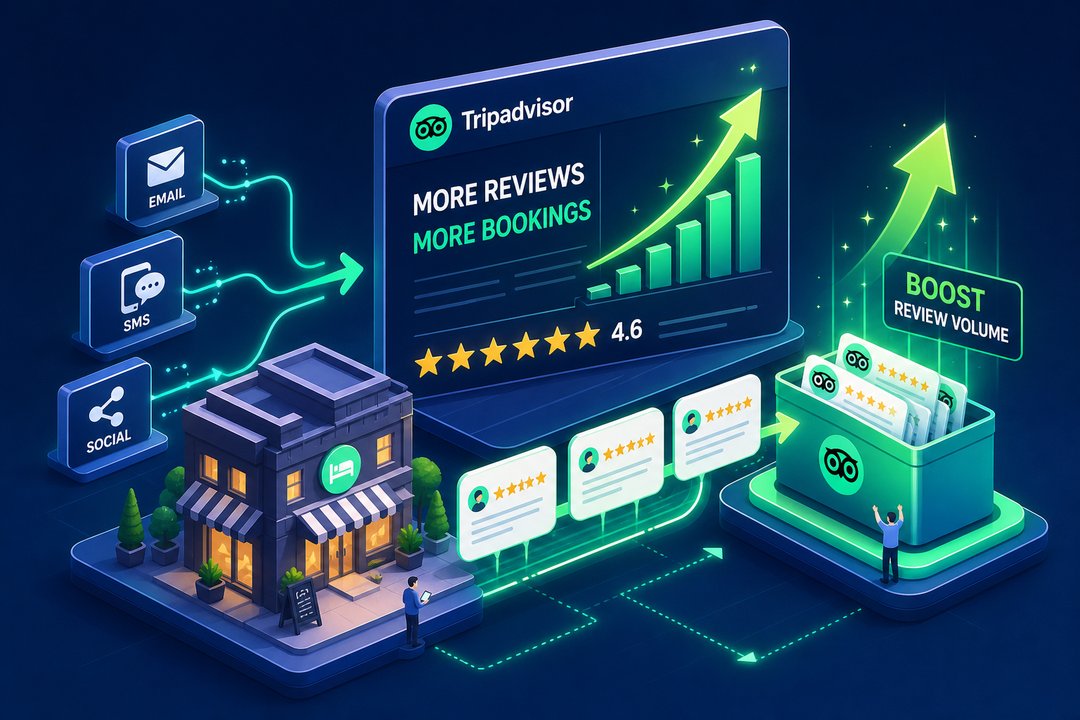
If your hotel’s goal is more positive online reviews and a better TripAdvisor or Google rank, a plain text review request beats a long survey by a wide margin. Survey forms convert at single digits to low teens. A stripped-back review request that asks for a star rating and a few sentences in the guest’s own words can return feedback at 25 to 50 percent.
The arithmetic is brutal. A hotel that emails 1,000 departing guests a month and gets a 5 percent survey completion rate ends up with 50 pieces of structured feedback. The same property sending a plain text review request at a 25% reply rate ends up with 250 first-person accounts, most of which can be redirected onto the public review platforms that actually drive bookings.
Why long hotel survey forms quietly bleed response rates
Long surveys fail because completion rates collapse with every additional question. Industry benchmarks from SurveyMonkey, Qualtrics, and Customer Thermometer all point in the same direction: the steepest drop in survey completion happens between the third and seventh question, and any post-purchase survey that exceeds eight questions tends to settle into a 5 to 10 percent completion rate. That’s before you account for email spam filters that will probably divert that graphic-heavy templated email directly to the junk folder!
For a hotel, the situation is worse than the industry average. Guests have already given the property money. They have already given up their time at check-in, check-out, breakfast, and probably at least one front-desk conversation. Asking them to also rate the lobby decor, the breakfast service, the dinner service, the gym lighting, the in-room amenities, the staff politeness, and the value for money on a series of one-to-five scales is asking for a favour. Most guests politely decline.
A week of four Nespresso capsules
I once stayed at a Ritz-Carlton for a week, paying several hundred dollars a night, and had a lovely stay. The room was spacious, the location great, the staff were friendly, the breakfast was good, and the service was attentive. There was one issue. Housekeeping gave me four Nespresso capsules on day one and never replaced them. When I asked, I was told I would be charged for any extra capsules.
I remember thinking the obvious thought. If I were staying for one night I would get four capsules, but for seven nights I still only get four, so should I check out every morning and check back in for the same room? The retail cost of a Nespresso capsule is less than 50p - a generic capsule is much less. The cost of irritating a paying guest by being seen to ration them is much larger.
A few days after I checked out, the Ritz-Carlton sent me a survey email through one of the big enterprise survey platforms. It was the kind of survey hotel groups commission to feed back-of-house operations dashboards: a slick template, a brand banner, a corporate footer, and fifteen or so questions in sequence. I started in good faith. Check-in. The room. Breakfast. Dinner. Staff. Around question ten I gave up. Somewhere in the abandoned form was the one paragraph that would have helped the property the most, which was that their week-long guest had a great stay and was irritated by a four-capsule policy that costs them effectively nothing. They never got it. It's ironic because the stay I'm talking about happened over 10 years ago, but whenever I think of the Ritz-Carlton brand, NespressoGate pops straight into my head!
An amazing stay can be tainted by the silliest detail. A long survey is the worst possible tool for catching that detail, because the one guest who would tell you politely gives up mid-survey.
What a real hotel review request looks like in practice
ReviewFilter takes the opposite approach: a plain typed email that looks like it came from a senior person at the hotel rather than from an automated marketing system, with a link to a mobile-responsive page where the guest leaves a one-to-five star rating and writes their feedback in their own words. The top properties on our platform achieve feedback rates as high as 50 percent. Averages sit comfortably in the high twenties.
The email design is doing more work than people expect. A graphic-rich, brand-heavy survey email is filtered as promotional by Gmail and as low-priority by Outlook. A plain text email that reads like the general manager wrote it lands in the primary inbox, gets opened, and gets read. The conversion gap between the two formats is not subtle. We have seen the same property double its feedback rate by switching the visual template alone.
There is another effect. When you ask a guest to give a rating and write a short note in their own words, they tell you what they actually noticed. Sometimes that is the bed. Sometimes that is the staff. Sometimes that is a four-capsule Nespresso policy. The signal arrives whole, in the guest’s own voice, which is the same voice that posts to TripAdvisor and Google. From a positive review, ReviewFilter prompts the guest to post their words publicly. From a critical one, the property gets a private heads-up and the chance to fix it before anyone else hears about it. That second flow is the same operational logic discussed in our piece on OTA review management for boutique hotels.
Hotel survey vs review request: where each one earns its keep
Long surveys are not useless. They just answer a different question. A 200-room flagship hotel inside a global brand needs structured Likert-scale data to feed CSAT dashboards, to compare property A in Frankfurt with property B in Tokyo, and to feed operational reviews back at headquarters. For that purpose, a ten-question survey is fine and the single-digit response rate is acceptable, because the absolute number of responses is still large.
For most independent and boutique hotels, that is not the question being asked. The question is whether the guest is willing to publicly recommend the property on the platforms potential guests actually consult before they book. A long form survey is built for internal reporting. A plain review request is built for public proof.
If your goal in 2026 is to climb the TripAdvisor rank for your location, to nudge your Google Business Profile rating up by a quarter of a star, or to surface more recent, named, specific guest feedback on your own website, the right instrument is the one your guests will actually respond to. See the Lite, Core and Pro plans for the hotel reputation management software that will get you a higher conversion rate.